


Examining the Wisdom of the Man Who Taught Us How to Question
By Kyu-jin Lee, Ph.D.
A World in Transition
Socrates lived during a time when the 5th century BC was a pivotal era of civilization. In Athens, democracy was in full bloom; citizens gathered in the Agora to debate and vote. While the world was shifting, different regions were carving out their own paths: Rome was navigating the early stages of a republic, Egypt was struggling under Persian rule while maintaining its scientific brilliance, and China was embroiled in the chaotic Warring States period, which gave rise to great thinkers like Confucius and Laozi.
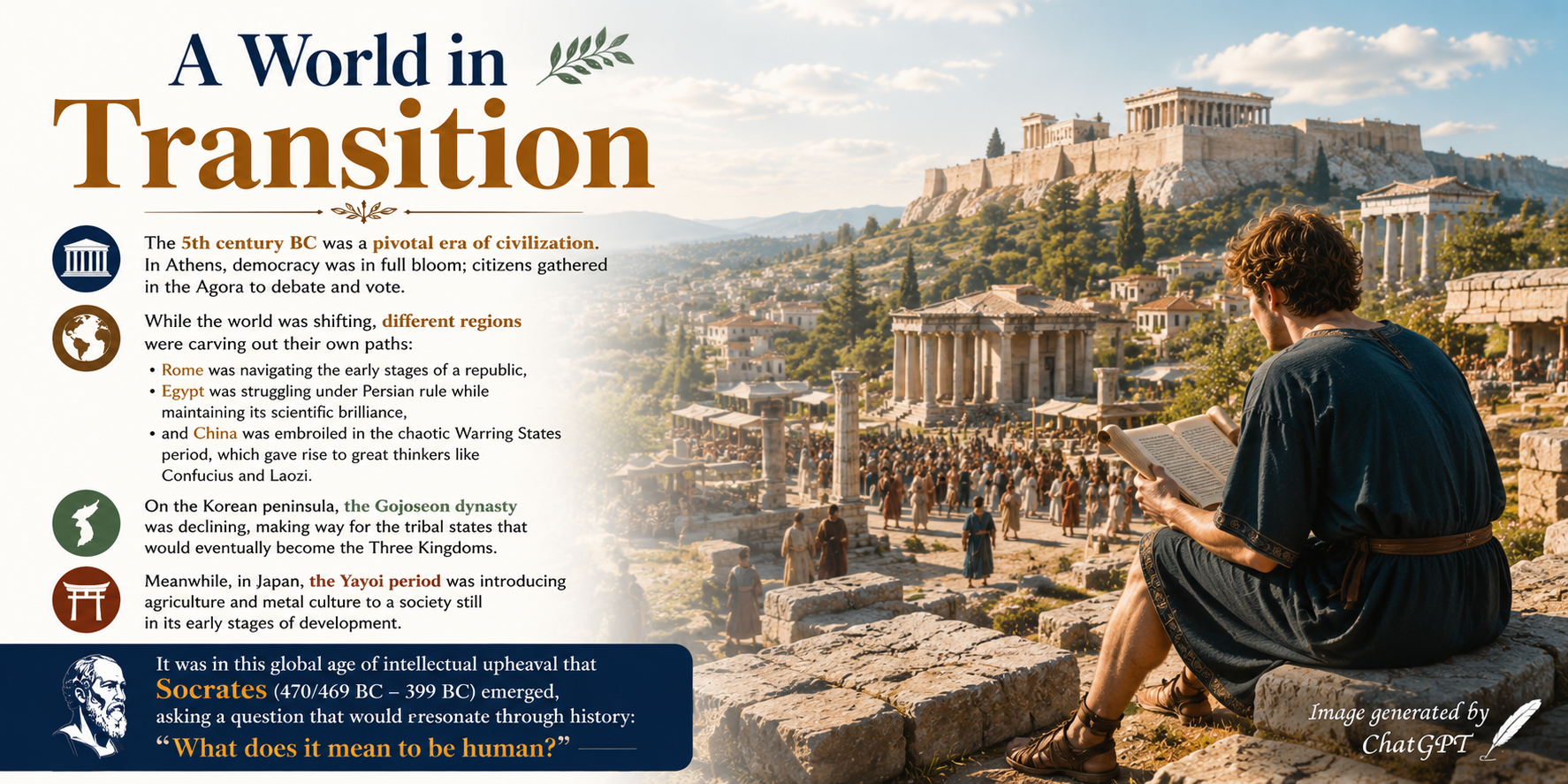
On the Korean peninsula, the Gojoseon dynasty was declining, making way for the tribal states that would eventually become the Three Kingdoms. Meanwhile, in Japan, the Yayoi period was introducing agriculture and metal culture to a society still in its early stages of development. It was in this global age of intellectual upheaval that Socrates (470/469 BC – 399 BC) emerged, asking a question that would resonate through history: “What does it mean to be human?”
The Man Who Questioned in the Agora
In the heart of Athens, one man stood out—not because he lectured, but because he asked. Socrates had no classroom and wrote no books. Instead, he walked the streets, engaging citizens in dialogue. His weapon was not rhetoric, but the question.
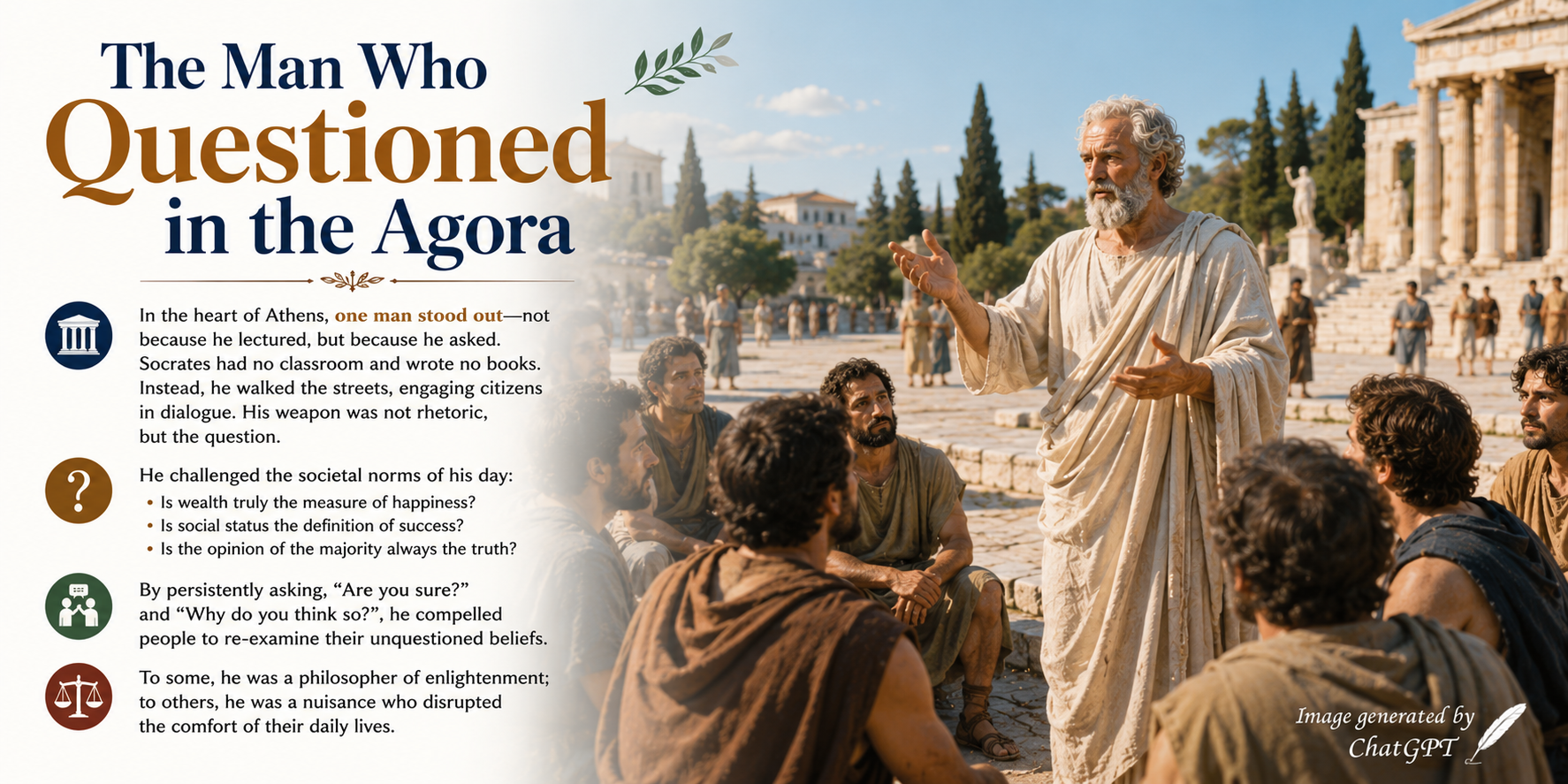
He challenged the societal norms of his day: Is wealth truly the measure of happiness? Is social status the definition of success? Is the opinion of the majority always the truth? By persistently asking, “Are you sure?” and “Why do you think so?”, he compelled people to re-examine their unquestioned beliefs. To some, he was a philosopher of enlightenment; to others, he was a nuisance who disrupted the comfort of their daily lives.
Happiness Through Knowledge and Reflection
Socrates did not define happiness as material possession or fleeting sensory pleasure. He believed that the path to happiness begins with the courageous admission of one’s own ignorance. His famous confession, “I know that I know nothing,” is not an expression of defeat, but the very starting point of true wisdom and reflection.
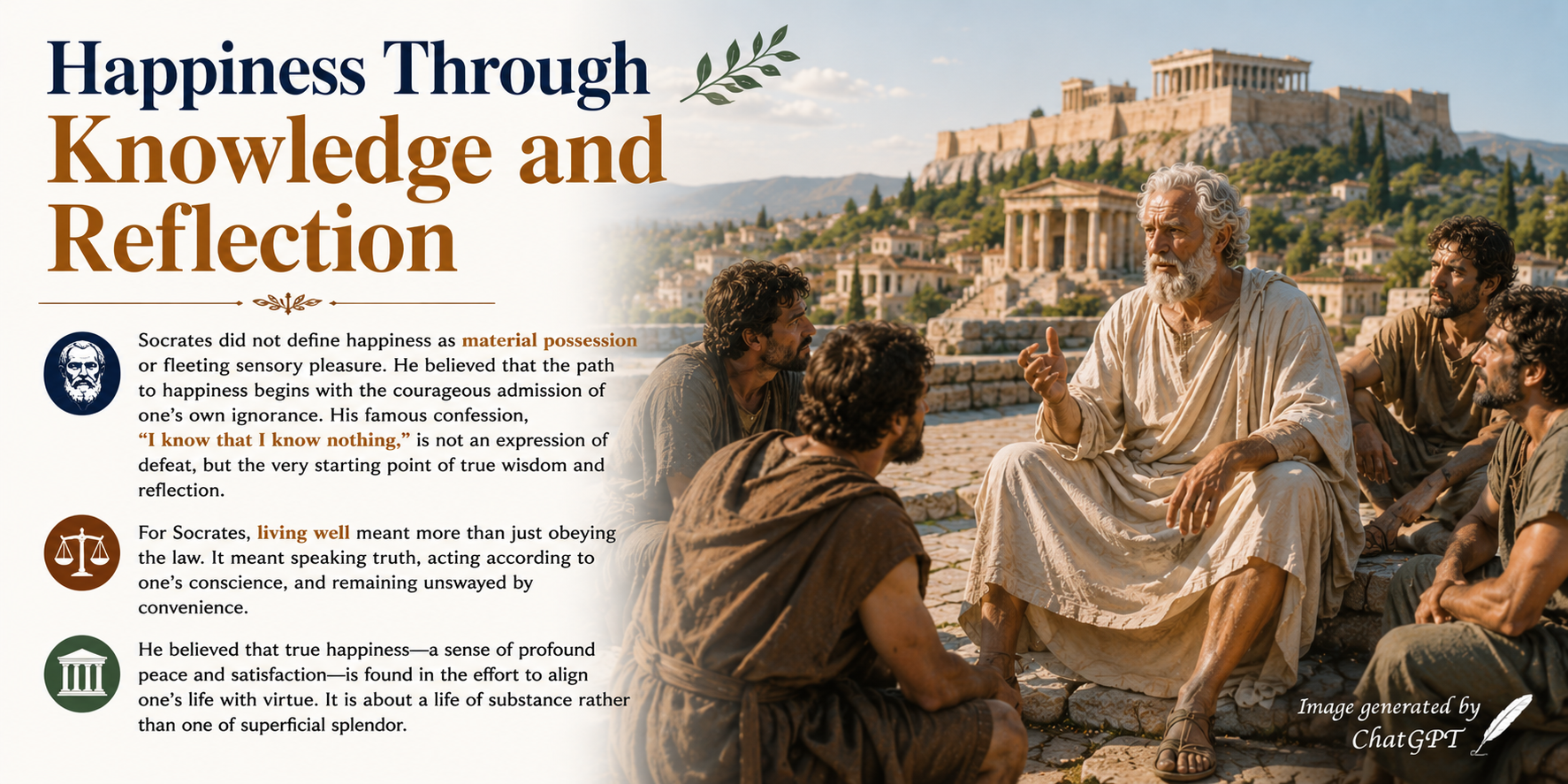
For Socrates, living well meant more than just obeying the law. It meant speaking truth, acting according to one’s conscience, and remaining unswayed by convenience. He believed that true happiness—a sense of profound peace and satisfaction—is found in the effort to align one’s life with virtue. It is about a life of substance rather than one of superficial splendor.
Conflict as a Practice of Equanimity
Socrates’ philosophy was not confined to the Agora; it was tested at home. His wife, Xanthippe, is historically known for her sharp temper. Legend has it that she once threw a bucket of water on him after a heated argument. Socrates’ calm response? “When it thunders, rain usually follows.”
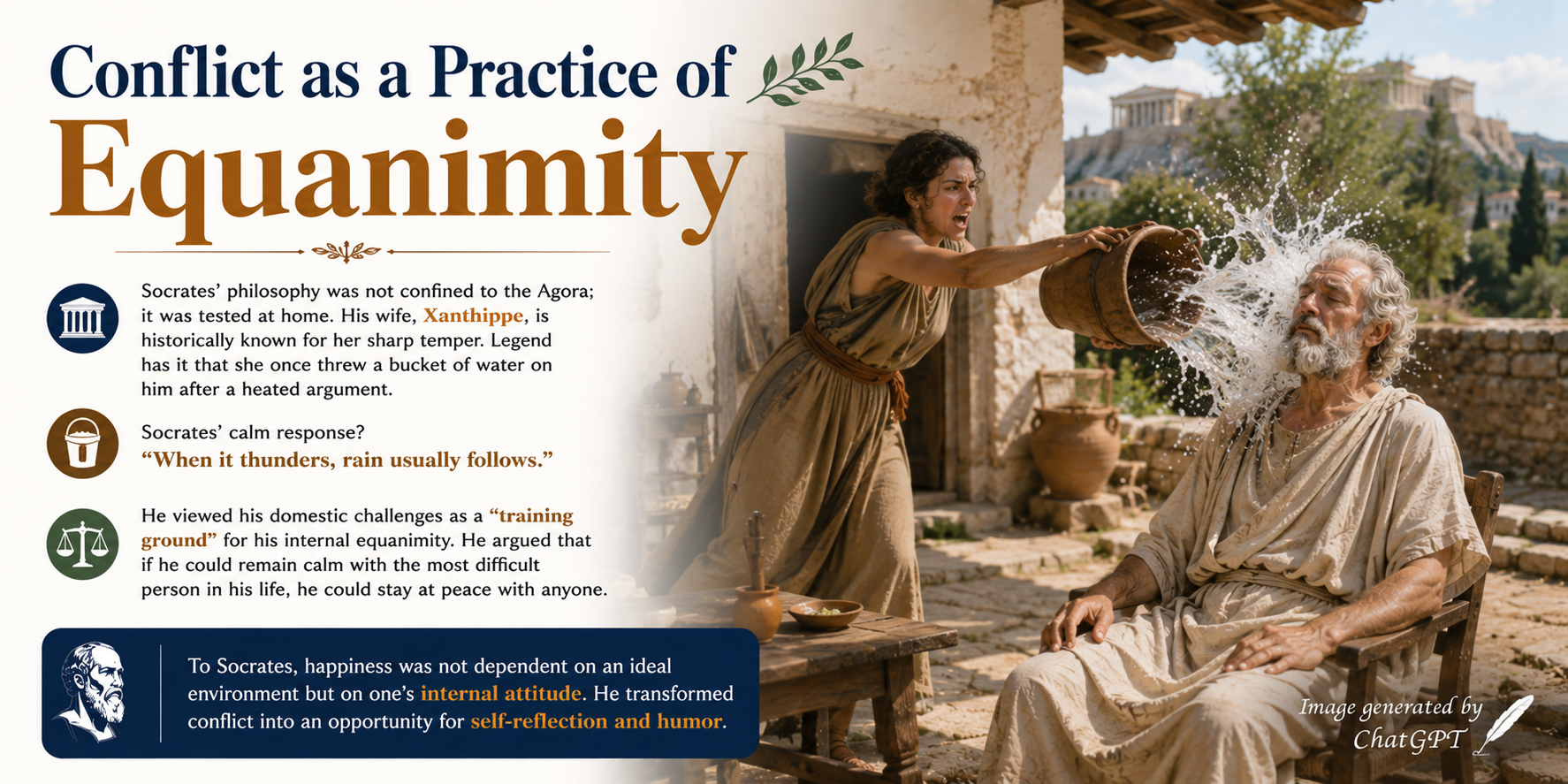
He viewed his domestic challenges as a “training ground” for his internal equanimity. He argued that if he could remain calm with the most difficult person in his life, he could stay at peace with anyone. To Socrates, happiness was not dependent on an ideal environment but on one’s internal attitude. He transformed conflict into an opportunity for self-reflection and humor.
The Martyr of Philosophy
In 399 BC, Socrates was brought to trial on charges of corrupting the youth and introducing new deities. Behind the accusation lay the political instability of a post-war Athens and a deep-seated fear of an intellectual who challenged traditional authority.
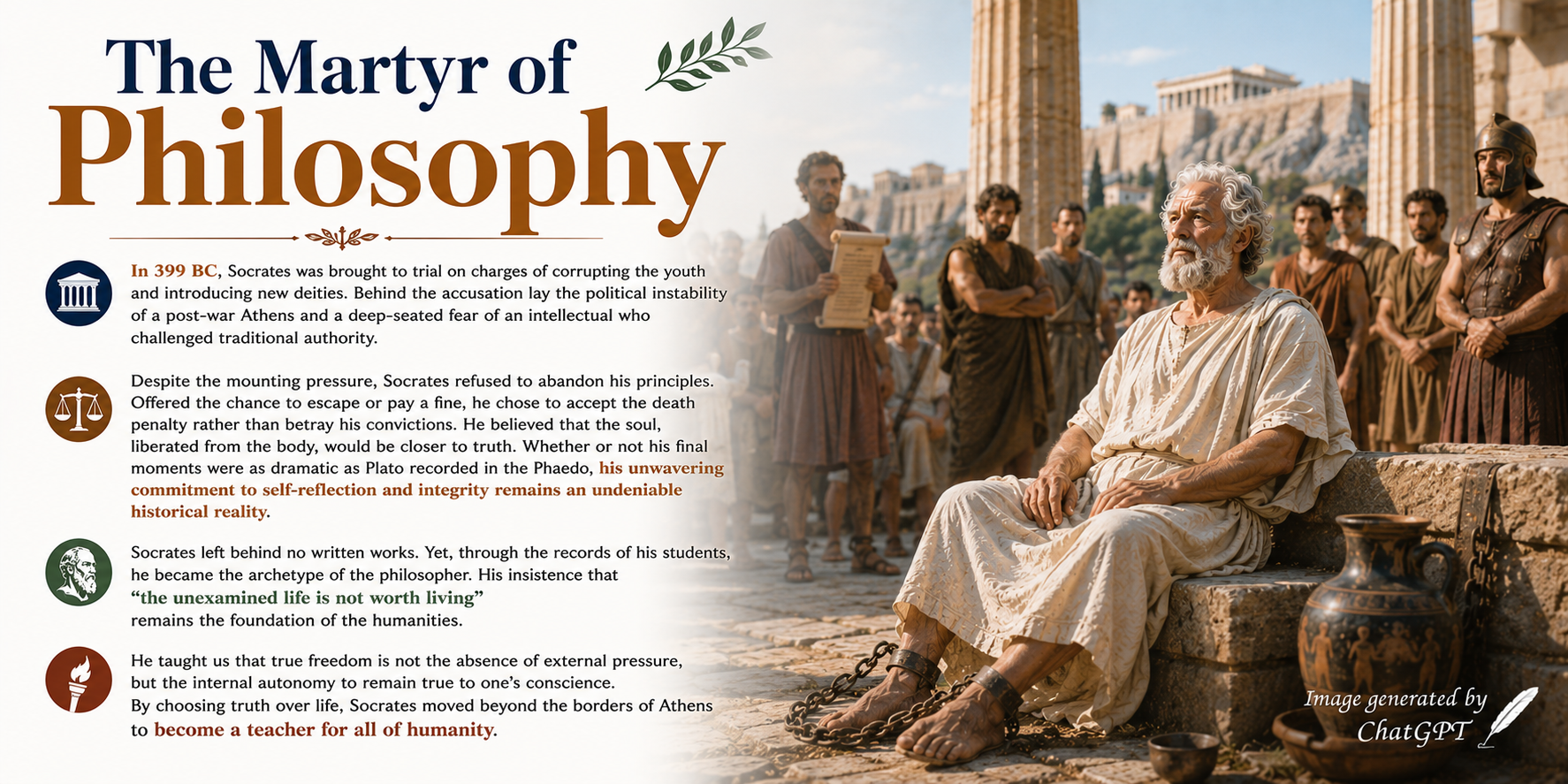
Despite the mounting pressure, Socrates refused to abandon his principles. Offered the chance to escape or pay a fine, he chose to accept the death penalty rather than betray his convictions. He believed that the soul, liberated from the body, would be closer to truth. Whether or not his final moments were as dramatic as Plato recorded in the Phaedo, his unwavering commitment to self-reflection and integrity remains an undeniable historical reality.
Socrates left behind no written works. Yet, through the records of his students, he became the archetype of the philosopher. His insistence that “the unexamined life is not worth living” remains the foundation of the humanities. He taught us that true freedom is not the absence of external pressure, but the internal autonomy to remain true to one’s conscience. By choosing truth over life, Socrates moved beyond the borders of Athens to become a teacher for all of humanity.
Note: This article is an English adaptation of the original Korean essay, “[철학자와 행복 1편] 소크라테스의 삶 (Philosophy and Happiness: Part 1 – The Life of Socrates),” written by Kyu-jin Lee, Ph.D.